

La Vecchia Signora vs The New Guard: What Juventus' 90s Crest Revival Means for the Next Generation of Calcio Fans
To understand the soul of Turin is to understand the gravity of a silhouette: the curve of an oval, the weight of a crown, and the charging spirit of a bull. In the hallowed halls of Italian football, where history is written in black and white, the crest is not merely a brand; it is a sacred lineage. For decades, La Vecchia Signora: The Old Lady: carried her history with a heraldic grace that felt more like a royal decree than a sports logo.
But as the digital age accelerated and the world grew smaller, the heraldry was stripped away. In 2017, the world met the "J": a minimalist, corporate distillation of an empire. Yet, in the streets of Milan, the cafes of Turin, and the burgeoning streetwear scenes of New York and London, a quiet rebellion has taken hold. The New Guard of Calcio fans are not looking for the future; they are reclaiming the past. The revival of the 90s crest is more than a trend: it is a reclamation of identity, a return to the roots of a club that once defined the very zenith of European football.
The Oval Shield: A Relic of Royal Turin
Before the "J" sought to colonize the lifestyle space, the Juventus crest was a masterpiece of tradition. The oval shield, housing the bull of Turin and the golden crown, was a visual echo of the city’s baroque architecture and its industrial might. It spoke of the Agnelli family, of the Fiat factories, and of a team that didn't just play football: it commanded it.

For the generation that came of age in the 90s, this badge was the sun around which the footballing universe orbited. It was the era of the Stadio delle Alpi, of fog-drenched nights in Piedmont, and of a team that possessed an almost terrifying elegance. When a young fan today reaches for a Serie A inspired t-shirt bearing that classic oval, they aren't just wearing cotton: they are donning a piece of the city's heraldry. They are signaling that they understand the difference between a global brand and a local institution. This is the essence of La Vecchia Signora: a nickname that suggests wisdom, longevity, and a refusal to be rushed by the whims of modernity.
The Minimalist Schism: When the 'J' Met the Street
The introduction of the minimalist "J" was a tectonic shift. It was designed to live on sneakers, on luxury handbags, and in the digital ether. It was a bold, edgy statement that Juventus was no longer just a club, but a "way of living." While it succeeded in moving the needle of global marketing, it created a vacuum of soul that the New Guard has been quick to fill with nostalgia.
The younger generation, those discovering Calcio through grain-heavy YouTube highlights and vintage fashion archives, see the "J" as the uniform of the boardroom. But the 90s crest? That is the uniform of the Curva. It represents a time when Italian football was the undisputed center of the world, a time when every Sunday felt like a grand opera. Wearing a retro Italian football tee featuring the old badge is a way of opting out of the sterile corporate aesthetic and opting into a story that has been told for over a century. It is a badge of honor that says, "I know where this began."
Pinturicchio: The Artist of the Delle Alpi
No discussion of the 90s revival is complete without mentioning the man who wore the crest like a second skin: Alessandro Del Piero. Nicknamed Pinturicchio by the legendary Gianni Agnelli, Del Piero was the artist-in-residence at the Delle Alpi. His game was a blend of technical mastery and poetic intuition: a style that mirrored the very crest he wore.
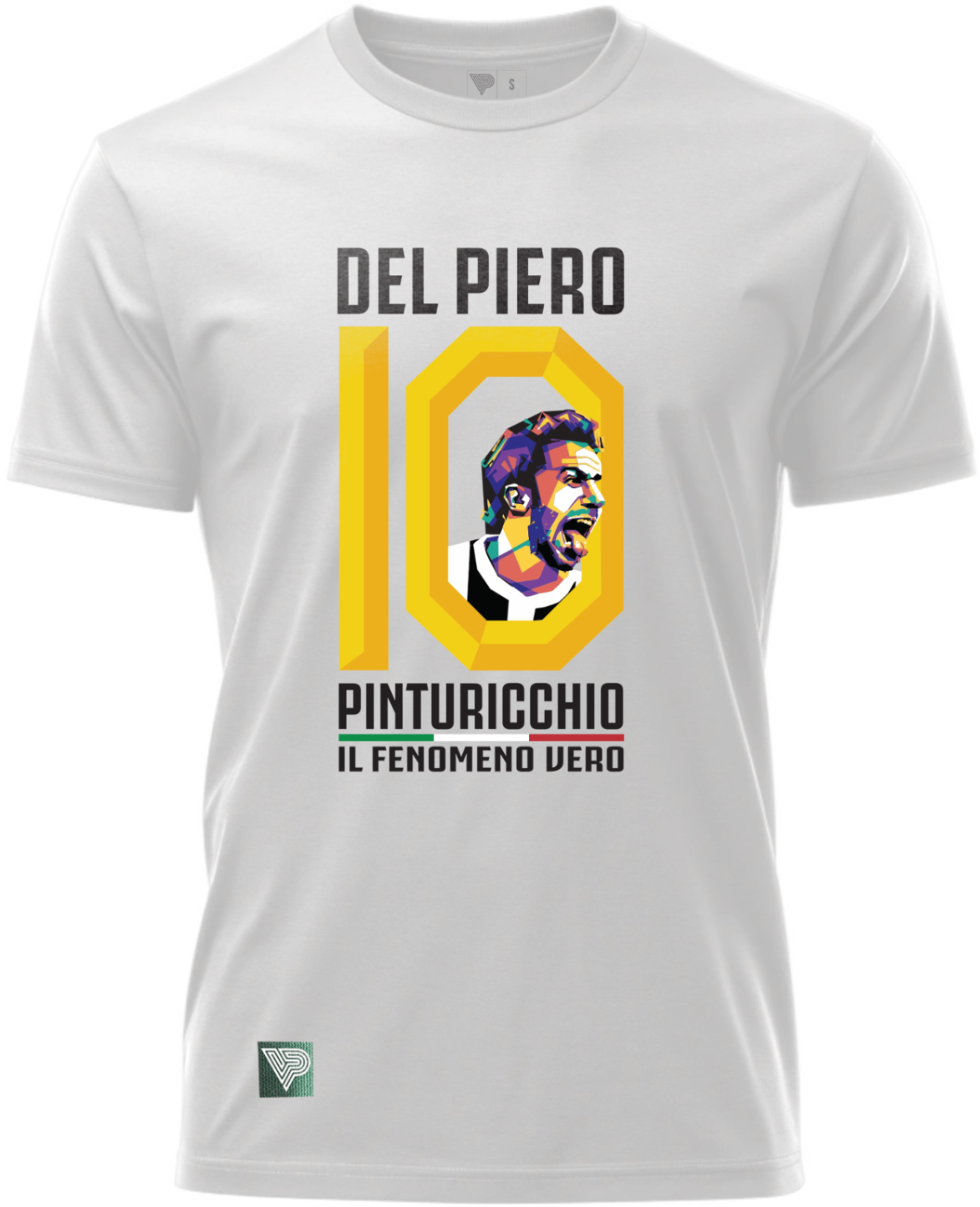
When we designed our Del Piero Tribute T-Shirt, we didn't just want to create apparel; we wanted to capture the "Pinturicchio" era. The bold, geometric numbers, the Italian flag accents, and the phrases that echo through the history of Turin: Il Fenomeno Vero. This is the language of the New Guard. For a Gen Z fan in London or a millennial in Los Angeles, Pinturicchio Del Piero represents a standard of cool that transcends the sport. He is the bridge between the grit of the 90s pitch and the elevated aesthetic of modern Italian football streetwear.
Calcio & Cucina: The Lifestyle of the Tifoso
In Italy, football is never isolated. It exists in the steam of a morning espresso, in the crackle of the Gazzetta dello Sport, and in the slow-cooked traditions of the kitchen. Our "Calcio & Cucina" philosophy is born from this realization: that the beautiful game is best enjoyed with a side of culture.

The revival of the 90s crest fits perfectly into this tapestry. Just as a perfectly pulled shot of espresso requires the right pressure and the right beans, a perfect football aesthetic requires the right history. The New Guard understands this. They don't want fast fashion; they want "slow Calcio." They want pieces that have the texture of a Sunday morning in Turin, the weight of a legacy, and the distressed finish of a story well-told. This is why the 90s crest resonates: it feels hand-crafted, intentional, and deeply rooted in a place where food, sport, and life are one and the same.
From the Curva to the Corso: The New Guard’s Uniform
We are witnessing a moment where the stadium and the street are no longer separate entities. The modern fan is a cultural curator, blending technical sportswear with high-fashion sensibilities. In this new landscape, the 1990s Juventus badge has become the ultimate "if you know, you know" signifier. It is the core of the Italian football streetwear movement: a movement that prioritizes the texture of the past over the polish of the present.
Whether it's the iconic number 10, the "Divin Codino" of Baggio, or the sheer dominance of the Lippi era, the icons of the 90s provide the visual vocabulary for today's fashion-conscious supporters. They are looking for authenticity in an age of replicas. They are looking for a connection to a golden era that they might not have witnessed firsthand, but which they feel in every thread of a vintage-inspired design.
Legacy on Your Sleeve
Ultimately, the revival of the 90s crest is a testament to the enduring power of storytelling. Juventus may have moved into the future with a minimalist "J," but the heart of the club: the spirit of the Old Lady: remains firmly entrenched in the heraldry of her prime. To wear the old badge is to participate in a grand tradition. It is to say that you value the bull and the crown over the sleek lines of a marketing agency.
At Vintage Pitch, we don't just make shirts; we curate memories. We bridge the gap between the legends who graced the pitch and the fans who carry their legacy into the streets of 2026. The 90s crest is back, not as a relic, but as a living, breathing symbol of what it means to be a Juventino. It is the ultimate badge of cultural identity.
A tribute to the past. A uniform for the future. Wear the legacy.